

Key Industry Standards Supported?
5G and Future Standards
MHF® 7S offers advanced solutions for 5G mm Wave up to 15 GHz typically IF bands used for communication between antenna and modem SoC. The complexity of larger devices necessitates using longer-length harnesses to connect antennas to RFICs. Devices include Notebook PCs (NBPC), Small Cells, and Customer Premises Equipment (CPE). MHF® 7S effectively addresses numerous distinctive challenges associated with 5G devices. I-PEX is at the forefront of enabling innovation in the 5G landscape.
Wi-Fi 7, Wi-Fi 6E
Wi-Fi 7 extends the capabilities of Wi-Fi 6E by integrating the 6 GHz band, which spans from 5.925 to 7.125 GHz, to facilitate higher data transfer speeds and increased capacity. This advancement enhances stability when multiple devices are connected simultaneously and contributes to energy efficiency. The MHF® I and MHF® 4L connectors are designed to accommodate frequencies of up to 9 GHz and 12 GHz respectively.
M.2 Standard
MHF® 4 and MHF® 4L are industry-standard M.2 connectors explicitly designed for high-frequency radio frequency (RF) modules commonly utilized in various applications. These connectors ensure reliable connectivity in devices such as notebook personal computers (NBPCs) and cellular machine-to-machine (M2M) communication radio modules. By adhering to the M.2 standard, MHF® 4 and MHF® 4L provide a compact and efficient solution for integrating RF modules, enabling seamless wireless communication across a wide range of consumer electronics, industrial IoT devices, and mobile applications. Their design ensures optimal performance where space and signal integrity are critical.
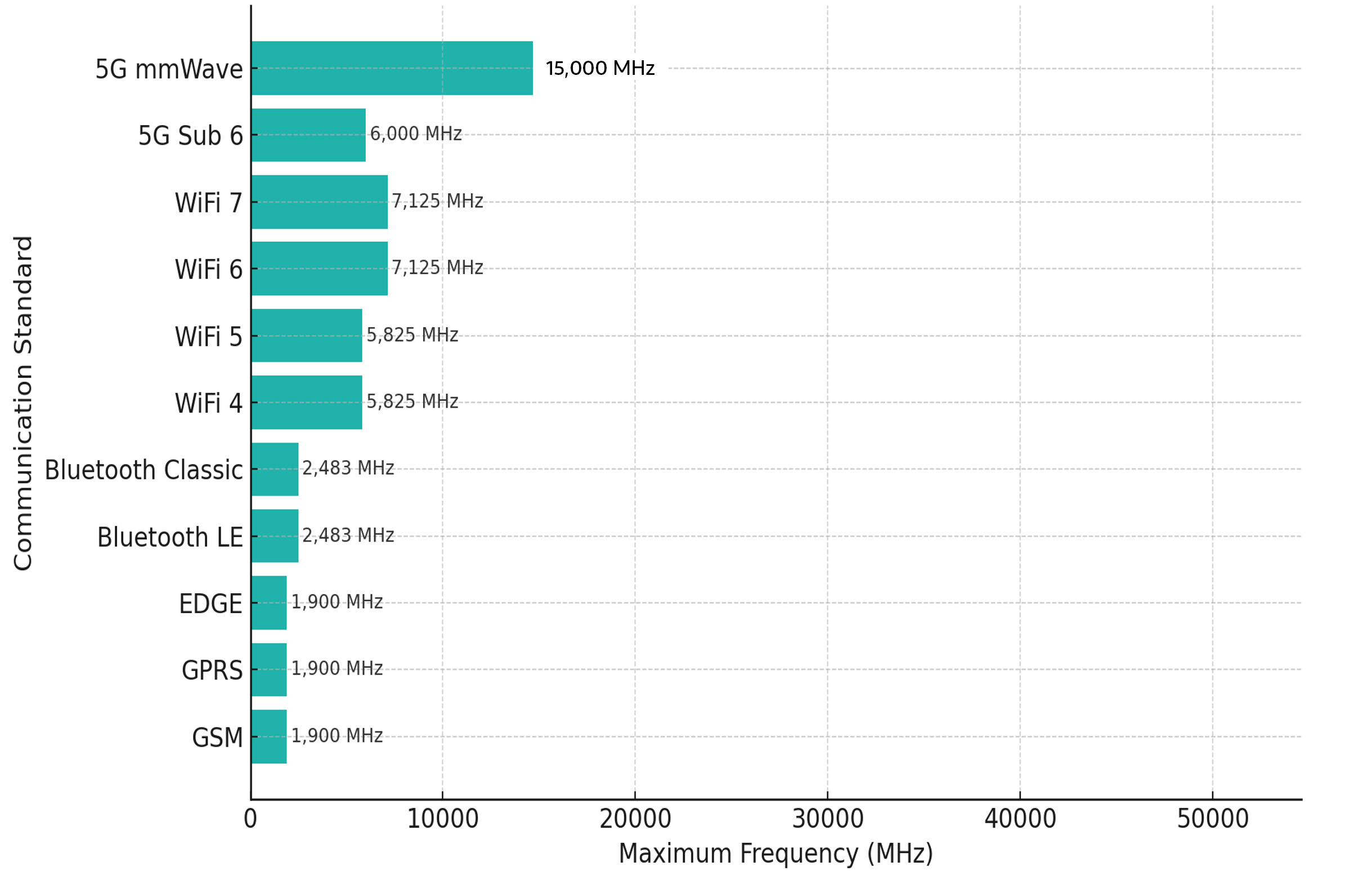
Graph in Figure 1 below shows a comparison of maximum frequencies of some of the industry standard common wireless communication protocols supported by MHF series connectors.
What is a RF Connector?
- 1. Compact Size and High Density of MHF Connectors for Portable Systems?
- 2. High Frequency and Data Rates for Modern High Speed Designs?
- 3. Superior EMC Performance with Integrated 360 degrees EMI ZenShielding?
- 4. Offers High Design Flexibility with Various Sizes and Multiple Cable Options?
- 5. Robust Design with Integrated Locking Features?
- 6. Key Industry Standards Supported?
- 7. Consistent Performance with i-Fit® Technology?
- 8. MHF Switch Products for Antenna Testing?
- 9. Available Accessories for MHF Connectors?
- 10. PCB Stack Up Optimization Services?


