High Temperature Resistance
High temperature resistance is critical for FPC/FFC connectors since often, these connectors are used in compact system modules where heat density is high, airflow is limited and thermal cycling is quite frequent. Examples include circuit boards with processors, batteries, cameras and power circuits in smart phones, automotive electronics, wearables and camera systems etc. Connectors rated for higher operating temperatures maintain electrical and mechanical performance even when operated close to maximum specified temperature. They degrade much more slowly over time and are qualified for thermal aging and cycling.
I-PEX provides high-temperature-resistant FPC and FFC connectors in its EVAFLEX® and MINIFLEX® series products which are engineered to withstand harsh thermal environments, leveraging decades of development experience and proprietary design technology. The connectors are designed to maintain stable electrical and mechanical performance even in applications requiring continuous operation at elevated temperatures up to 125°C, delivering high performance under harsh operating conditions such as those found in automotive and industrial equipment.
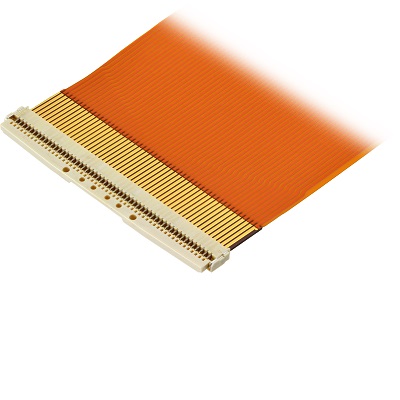
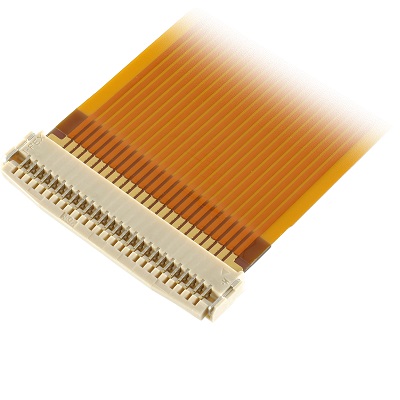
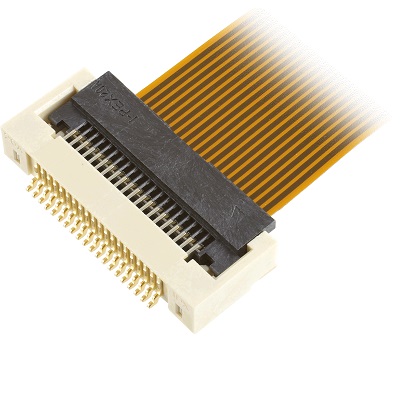
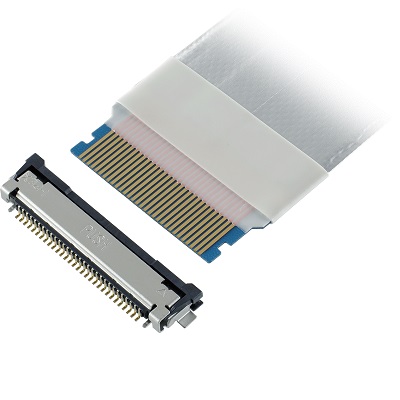
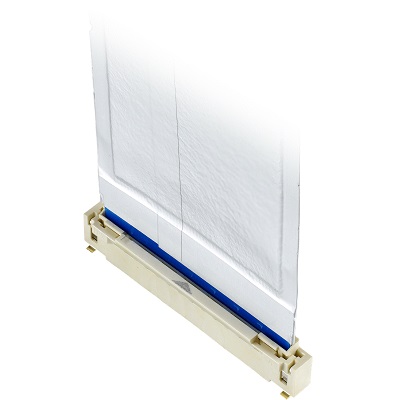
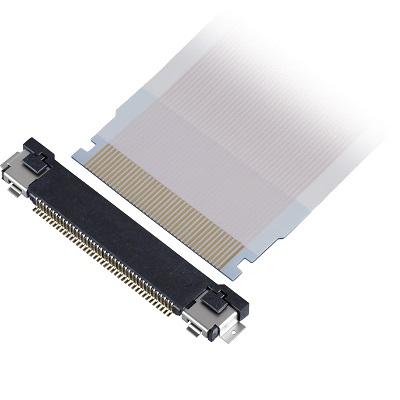
Table 1 below shows the select few connectors from EVAFLEX® and MINIFLEX® series connectors that are specified to operate at higher temperatures of 105℃ and 125℃ for reference.
Product type |
FPC/FFC Connectors |
|||||
Product Name |
MINIFLEX® 5-BFN II |
MINIFLEX® 5-BFN II LK |
MINIFLEX® 5-FF |
EVAFLEX® 5-VS Type CH |
EVAFLEX® 5-SE-G VT |
EVAFLEX® 5-SE |
 |
 |
 |
 |
 |
 |
|
Heat resistance |
125℃ |
125℃ |
125℃* |
105℃ |
125℃ |
FFC: 85℃
|
Pitch |
0.5 mm |
0.5 mm |
0.5 mm |
0.5 mm |
0.5 mm |
0.5 mm |
Height |
1.0 +/- 0.1 mm |
1.0 +/- 0.1 mm |
2.55 +/- 0.2 mm |
1.9 +/- 0.1 mm |
6.6 +/- 0.3 mm |
2.4 +/- 0.2 mm |
Depth |
Actuator Open: 3.0 mm
|
Actuator Open: 3.0 mm
|
Actuator Open: 6.4 mm
|
4.95 mm |
3.9 mm |
5.9 mm |
Table 1. Featured connectors from EVAFLEX® and MINIFLEX® series products specified for high operating temperature
It is important to select the right connector for high temperature applications since if a connector is exposed to temperatures beyond its design limits, several electrical and mechanical parameters can drift or fail. Increase in the contact resistance, poor signal integrity including Increased resistance and impedance variation, insulation resistance drop and current carrying capacity reduction are some of the common electrical issues seen in such conditions. When it comes to mechanical performance, contact force loss, housing deformation, creep and dimensional instability and locking mechanism failure are some of the likely issues associated with high temperature operation, if operating temperature specifications are not followed properly.
For these reasons, I-PEX selects materials with excellent workability, dielectric properties, and thermal conductivity, as well as stress relaxation characteristics that stabilize spring characteristics even in high-temperature use environments, and materials that can ensure consistent contact. Use of contact material like phosphor bronze and Corson alloy is one of the design parameters along with the contact geometry to ensure high performance at elevated temperatures. By employing heat-resistant materials and design that optimizes spring characteristics, stable contact reliability is ensured. To ensure stable electrical contact, a certain level of contact pressure is required between the contact and the mating component.
I-PEX uses high-temperature-resistant metallic component for the contact elements and design them in a spring configuration, enabling the structure to maintain optimal contact force over an extended period. As a result, I-PEX products are capable of maintaining consistent performance even in high-temperature environments of up to 125°C. Figure 2 shows the typical spring contact structure in high temperature rated I-PEX connectors.
I-PEX has conducted demanding tests required for automotive applications, including temperature cycling (-55 to +125°C, 100 cycles) and high-temperature endurance (125°C for 1,000 hours), and verified that no abnormalities were observed.
Detailed evaluation and test reports for I-PEX connectors are available here.