Reliability by Design
Reliability is designed into EVAFLEX® and MINIFLEX® series connectors with innovative locking designs. Hold down features provide additional robustness and the unique contact design allows the actuator operation without FPC inserted just in case in manufacturing environment. An actuator based locking mechanism in MINIFLEX® connectors also applies a controlled, repeatable normal force between contacts and pads—critical for consistent contact resistance. Actuators in connector designs provide zero insertion force for FPCs, prevent incomplete insertion, help in maintaining the connection with FPC, avoid any contact deformations and contact buckling.
The actuator in an FPC/FFC connector is the mechanical element that clamps the FPC/FFC in place, ensures stable electrical contact, and protects the connection from vibration and shock.
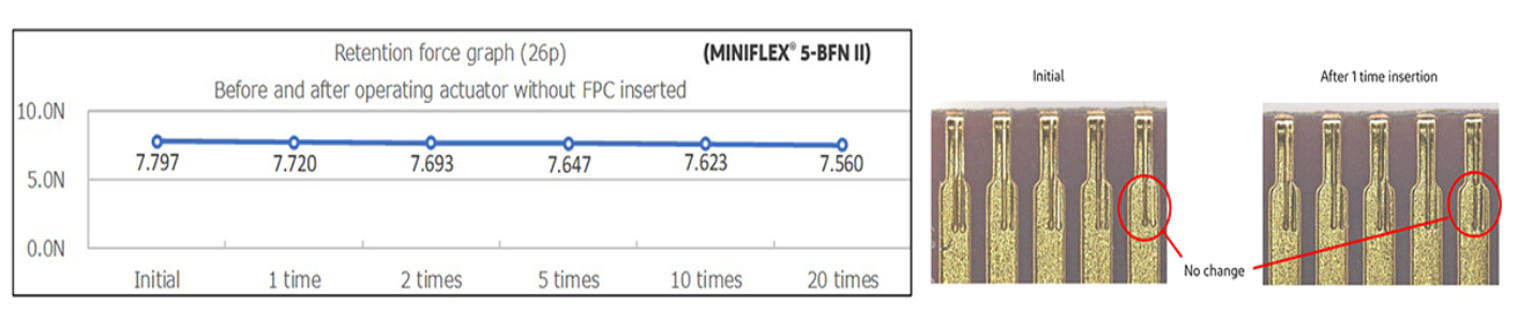
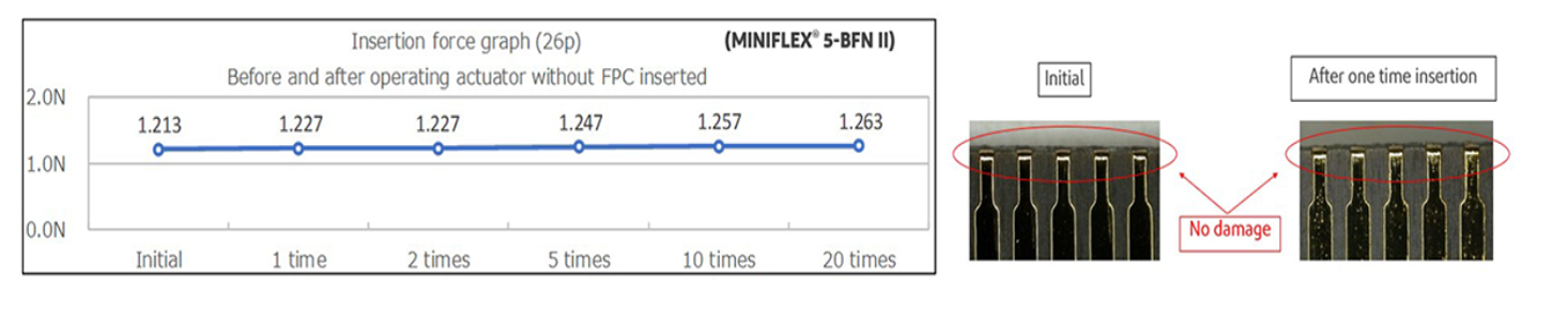
Hold down features of MINIFLEX® series connectors provide additional strength to the side walls of connector and in some cases, prevents the accidental fall off the actuator during assembly as shown in Figure 2. These connectors are also designed to operate undamaged with the ability to open and close the connector without the FPC inserted. Contact gap, insertion force and retention force remain almost unchanged after such operations as shown in Figures 3, 4 and 5 below.
Actuators in MINIFLEX® connectors improve reliability by applying even, repeatable pressure across all pins. This prevents intermittent connections, micro fretting, and long-term drift due to thermal cycling. A closed actuator significantly increases retention force and protects against FPC pullout during assembly and vibration in automotive/industrial designs and shock loads in handheld devices.
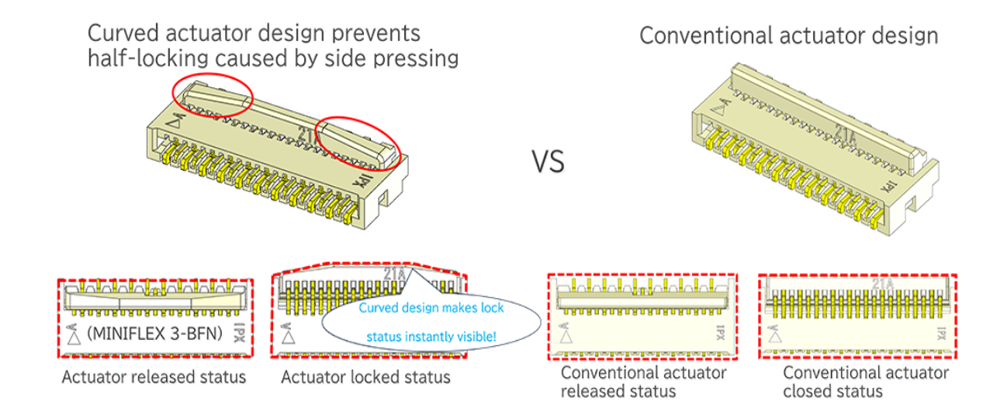
MINIFLEX® 3-BFN connector series has curved actuator design. Curved actuator design prevents half-locking, and enhances visibility of the locked state. The curved actuator design also allows easy visual confirmation of the lock status from the top as shown in Figure 1 below.
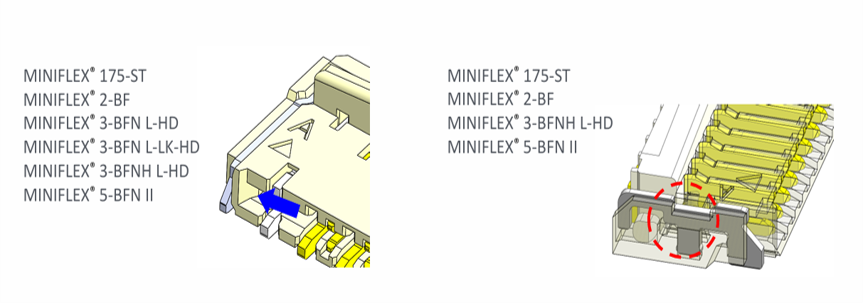
Hold down features of these connectors improve the strength of side walls, adding reliability by design. By soldering the hold-down, damage to the side walls at both ends of the housing during FPC insertion is prevented. as shown in Figure 2 below. It also prevents the actuator from dropping off by accident in some cases.
The chart in Table 1 below compares the test force for MINIFLEX® series connectors with and withhold Hold Down feature soldered to the board. This is the maximum force that can be tolerated by the side walls of the connector before breaking. The side wall strength has increased by almost 10 times with Hold Down feature.
| (N) | Without hold down | With hold down soldering | ||
| Test from outside | Inside out test | Test from outside | Inside out test | |
| AVG. | 2.353 | 2.257 | 23.790 | 21.720 |
| MAX. | 2.45 | 2.40 | 24.25 | 22.21 |
| MIN. | 2.24 | 2.12 | 23.41 | 21.24 |
Table 1. Comparison of Side Wall Strength With and Without Hold Down Feature in MINIFLEX® series connectors
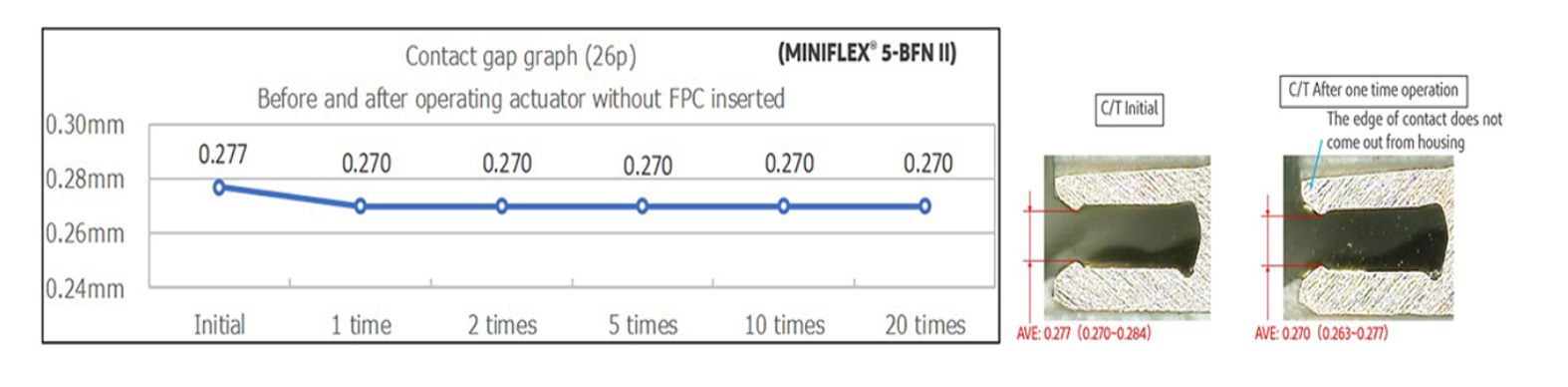
In the manufacturing environments, it is commonly seen that the actuators of connectors can be opened or closed accidentally without FPC inserted. The high density MINIFLEX® connectors from I-PEX are designed to operate reliably under such conditions. Figure 3 below shows that the change in contact gap of MINIFLEX® connector is minimal before and after operating the actuator without FPC inserted and connectors can still be used reliably.
Similarly, the change in insertion force of FPC is shown in Figure 4 below before and after operating the actuator of connector without FPC inserted. This change in Insertion Force is minimal and has no effect on the reliability of connectors.
Also, the change in retention force of FPC is shown in Figure 5 below before and after operating the actuator of connector without FPC inserted. Again, this change in Retention Force is minimal and connector still operates reliably.